
Tea Grown in the Mountain Valleys of Ibi, Gifu

Ibi, located in Gifu Prefecture, is a tea-producing region surrounded by mountains.
In addition to sencha, the area also produces tencha, the raw material used for matcha.
On this visit, we traveled to the Katsura Tea Cooperative to better understand how aracha (unrefined tea) is produced, which later becomes the base for teas finished by Shirai Seicha.

The region experiences hot summers and heavy snowfall in winter.
Large temperature differences and frequent morning mist create conditions where tea leaves grow slowly, developing their flavor over time.
Tea production under these natural conditions is carried out by the Katsura Tea Cooperative, an agricultural producers’ cooperative established in 1978. The group manages approximately 50 hectares of tea fields.
One of the first things we noticed on site was the orderly landscape of the tea fields.
The rows are carefully aligned in both direction and spacing, creating a uniform appearance.
These fields are designed for mechanization, and harvesting is carried out using ride-on harvesting machines.
The cooperative has also obtained JGAP certification, ensuring thorough management of cultivation and processing.
Fertilization and pest control are carefully scheduled, contributing to consistent quality.
Tea fields extend across the mountain slopes, reflecting the unique terrain of the region.
Aracha Processing
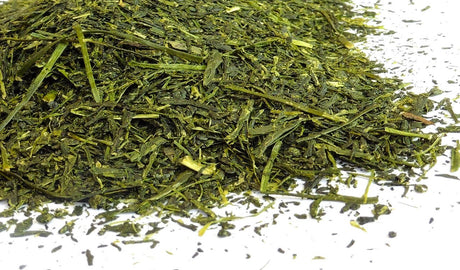
 Freshly harvested tea leaves are processed into aracha through steaming, cooling, and drying, with moisture levels adjusted step by step.
Aracha serves as a raw material and is passed on to the next stage of processing.
We visited in early April, before the start of the new harvest season in early May, and the factory was not yet in operation.
Inside the quiet facility, the processing equipment stood ready, giving a sense of the activity that will soon begin.
During the harvest season, large volumes of leaves are brought in, and processing lines are adjusted depending on leaf condition and timing.


35 Years of Tencha Production in Ibi
 In addition to sencha, the region also produces kabusecha and tencha, the raw material used for matcha.
One notable aspect is that the Katsura Tea Cooperative began producing tencha in 1991, making it one of the earlier producers in the region to adopt this production. This was well before the recent expansion of tencha facilities driven by growing demand for matcha.
The increasing global demand for matcha has led many regions to establish new tencha production facilities in recent years. In contrast, Ibi had already developed this capability decades ago.
The tencha factory is equipped with four traditional refractory brick furnaces. These furnaces, which use high heat to dry the leaves, remain in operation today and continue to support the production process.
In recent years, as demand for matcha has continued to rise, the importance of tencha production has also increased. Tea production in Ibi is therefore not limited to sencha, but also plays an important role in supplying raw material for matcha.

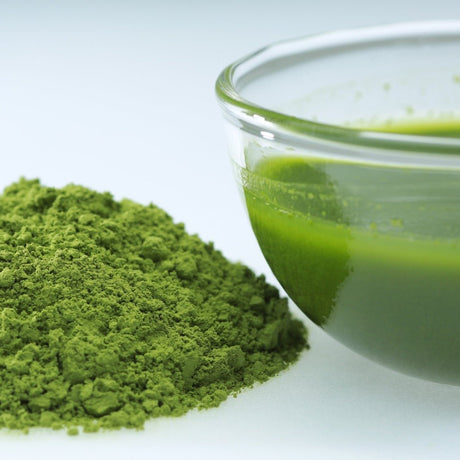
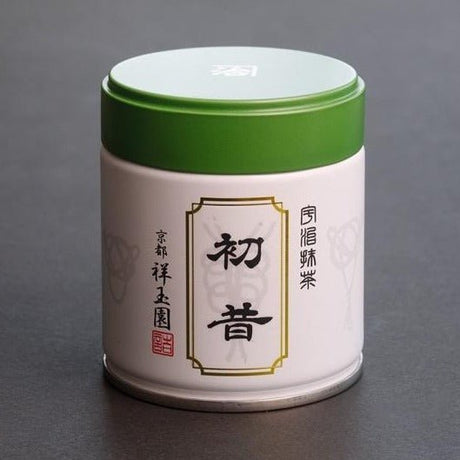
Rare Ibi-grown matcha from Gifu.
Distribution of Aracha
 Tea produced by the Katsura Tea Cooperative is shipped in the form of aracha.
Much of it is sent to Shizuoka, where it undergoes further refining and distribution.
In recent years, there has also been growing attention to overseas markets, and efforts to meet quality standards and requirements are advancing.
Final Processing
 Aracha is shipped to tea merchants both within and outside the region, where it is refined into finished tea products.
Within the Ibi region, there are also tea merchants who carry out final processing.
One of them is Shirai Seicha.
Shirai Seicha does not simply refine aracha, but carefully designs the final flavor of the tea by understanding its individual characteristics.
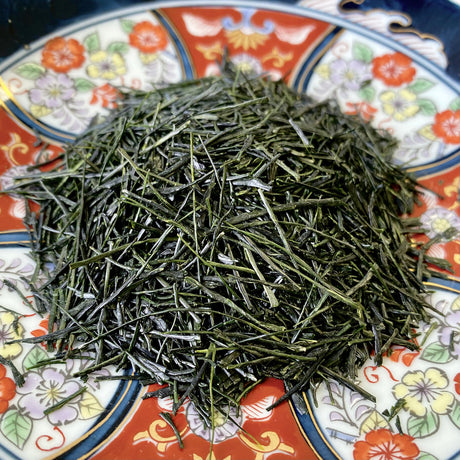
Key processes include the precise selection of stems and fine particles, firing to enhance aroma, and blending to balance flavor.
Through these steps, the company brings out the unique character of each origin while ensuring consistent quality and taste.
The Role of Blending
 Blending is an essential process to maintain consistent quality.
At Shirai Seicha, aracha produced by the Katsura Tea Cooperative is also used as part of these blends.

About the Tea We Are Introducing


Some of the aracha produced by the Katsura Tea Cooperative is sent to Shirai Seicha, where it is refined into finished tea.
The tea we are introducing here is one such example.
It is common for tea to be shipped as aracha and finished elsewhere.
At the same time, there are producers such as Nitta Seicha in Shirakawa who manage everything from cultivation to final processing.
Within this structure, tea-producing regions are also facing gradual changes, including a declining number of producers and increasing pressure to maintain production infrastructure.
At the Katsura Tea Cooperative, the number of producers has decreased from around 160 in the past to fewer than ten today.
Even so, tea production continues in this region, supported by dedicated producers such as Shirai Seicha and the Katsura Tea Cooperative.
The teas by Shirai Seicha featured here are characterized by their smooth, well-rounded depth and refined aroma.
Learn more here:
→ Explore Shirai Seicha Teas