

Get free shipping for a limited time when you use code FSMG26AG (conditions apply - limited 1 use per customer, limited to retail customers, minimum order of ¥5000 (US$30) or equivalent, expires automatically when used by 100 customers, not compatible with other discount codes)
Matcha Grades - Our Grading SystemSkip to our proposal for a new categorization of Matcha Types
The Japanese tea industry has traditionally not graded matcha. Matcha was made for the tea ceremony and was a very niche product until Haagen Daas introduced green tea ice cream in 1996 and Starbucks Japan introduced Matcha Latte in 2005. This was a catalyst for innovations in productivity (machine harvesting, machine milling, but also the unspoken use of sencha rolling machines instead of traditional tencha processing), and the "matcha" created were referred to as 加工抹茶 — "processing matcha" or "ingredient matcha". When I entered the industry in 2010, this was not considered "true matcha" by anyone.
Grading in Japan was never needed because the industry was a small one and limited to a few dozen companies, a few hundred farms. Market prices, informed by blind auctions and expert appraisers bidding on tencha, determined roughly the price and the price became an indication of quality. How a matcha was made (whether or not it followed historical traditional techniques, a combination of traditional and modern techniques, or even something completely different), was less important that the price (and therefore quality).
Terms like "ceremonial grade" and now "latte grade", "culinary grade" were introduced by importers in the West to make matcha more understandable, more marketable. As the demand for matcha outside Japan grew, production of matcha (as measured by tencha) grew from 1000 tons in 2010 to 4000 tons a decade later, and is now soaring even higher. With the majority of that production being exported, these western terms are being adopted by producers without clear definitions, and in 2025, the global matcha boom has completely skewed the price / quality ratio as demand / prices soared.
What is the difference between ceremonial grade, latte (barista) grade, and culinary grade? Since there is no objective standard nor industry standard, this list below attempts to describe how we are grading the matcha sold on Yunomi.life. It follows a spectrum of bitter/astringent to sweet/umami rich, coarse to fine grain, yellow to bright green color. Toastiness is also a desirable flavor quality but it can theoretically be achieved at every level with the right level of green roasting in refinement (among other techniques).
We are also in the process of creating a categorization system for "matcha" in the 21st century global industry that provides a language for transparency in production (see below)
Yunomi.life Matcha Grading System

Tasting method: 70-80C, 50 ml, 2g of matcha. Buy a spectrum sampler set here.
- A1 - Imperial Ceremonial Grade (80+ score) - An explosion of umami flavor with a creaminess, no astringency / bitterness, beautiful green powder and liquor color, fresh aroma. Smooth, silky texture.
- A2 - Premium Ceremonial Grade (70+ score) - Strong umami, minimum astringency and bitterness, beautiful green powder and liquor color, aroma may be weaker. Smooth, silky texture. Made from spring-harvested tencha.
- A3 - Standard Ceremonial Grade (60+) - Balanced umami / astringency / bitterness. Beautiful green powder and liquor color. Weak aroma. Texture is smooth.
- B1 - Premium Barista Grade (50+) - More astringency & bitterness than umami. Green powder and liquor color. Weak aroma. Slightly grainy texture. These characteristics make this grade perfect for lattes and mixing with other ingredients for creative beverages. Also called "latte grade" or "basic ceremonial grade".
- B2 - Standard Barista Grade (40+) - Strong astringency/bitterness, slightly dull green powder / liquor color. Little to no aroma. Slightly grainy texture. Recommended for daily lattes.
- K1 - Culinary Grade (30+) - Strong astringency/bitterness. Dull, more yellowish green powder / liquor color. Little to no aroma. Grainy texture.
- K2 - Culinary Grade (20+) - Very strong astringency/bitterness, very grainy texture, dull or yellow in color, no aroma.
- K3 - Industrial Grade (below 20) - Extremely strong astringency/bitterness, very grainy texture, dull yellow in color, no aroma.
Quantifying Subjective Tasting
Yes, in the end tastes and taste preferences are subjective. There is no avoiding that. Water may also be different and evaluation methods may differ. And finally, you need to know the full range of quality to know that a specific great tasting matcha is only a 7/10 in lack of bitterness, for example.
To systematize this subjective judgment of flavor quality I am proposing this system, with each criteria judged on a 10-point scale and weighted to a score out of 100:
- Strength of Umami 旨味 - 15%
- Strength of Sweetness 甘味 - 15%
- Strength of Creaminess コク - 15%
- Lack of Bitterness 苦味の無さ - 15%
- Lack of Astringency 渋味の無さ - 15%
- Texture - 10%
-
Color - 10%
- Overall Impression - 5% (5 out of 10 if it’s neutral—neither particularly good nor bad. This is where I give extra points if, for example, the matcha is nutty and toasty.)
Yunomi.life Matcha Types Categorization System
The basis of this system stems from three issues. First, "matcha" as it becomes a mainstream drink globally is organically moving away from its origins in the Japanese tea ceremony (Chanoyu) — consumers say "matcha" to refer to matcha lattes, they talk about visiting "matcha farms" rather than tea farms, and companies trying to hop onto the trend are calling many different things "matcha" - from black tea matcha to potato matcha.
Second, even if what is not traditionally "matcha" is obvious, what is "matcha" is very ambiguous even in the Japanese tea industry. While the world of Chanoyu defines matcha as being made from tencha requiring traditional techniques in cultivation and processing, the industrialization of matcha in the last half century has made the term very ambiguous. Sencha rolling machines can be repurposed to minimize rolling and dry tea leaves to become tencha-like (called "mogacha"), and the last autumn harvest of the year is rarely even shaded even though it is sold as low grade "matcha" despite everyone agreeing that matcha must be made from shaded leaves.
And finally, as matcha demand grows, it is creating a two tiered tea world of haves (those businesses involved in matcha) and have-nots (those farms especially who do not have access to tencha factories). In 2025, we are seeing more bankruptcies in the tea industry in a decade despite so many (matcha-involved) companies making much more money than before. How can we involve the greater tea industry?
I believe these issues are addressed by both expanding our definition of the term "matcha", redefining it for the global mainstream, and simultaneously becoming more specific in sub-types of this wider term. The following list is a work in progress, and we invite suggestions. Theoretically a type here could be combined with any of grades above, now that we have a way of separating type vs quality.
-
Heritage Matcha 伝統本抹茶 (Den-toh-hon-matcha) - uses only traditional cultivation and processing techniques and would be recognized as matcha by the Chanoyu (tea ceremony) world.
- Grown to be handpicked at harvest, shaded for 30-40 days under a canopy
- Steamed and dried in a brick tencha oven
- Ground by stone mill
-
Modern Matcha 本抹茶 (hon-matcha) - uses any combination of modern techniques to increase production volume and efficiency
- Instead of handpicking, scissors picking, machine picking etc may be used, and thus direct shading may be used
- Modern tencha drying machinery or other drying machinery repurposed for drying without rolling
- Ground by machine milling allowed - ball / bead mill pulverization, jet air pulverization, impact mill pulverization
-
Tea Leaf Matcha 茶葉抹茶
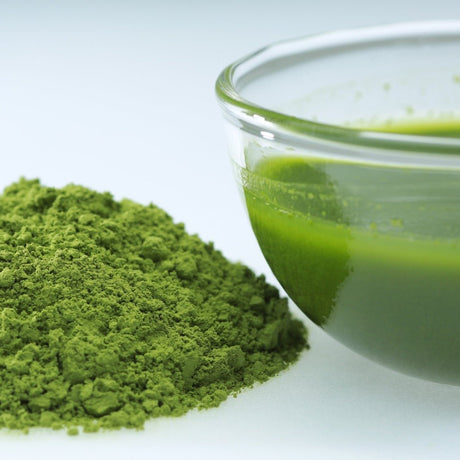
- Midori Matcha 緑抹茶- powdered non-tencha green tea leaves made to be fine enough that it becomes an alternative to Heritage or Modern Matcha, rather than a coarse powder that would make a good instant green tea. We are starting with a great one made from high grade Tamaryokucha.
- Oolong Matcha, Roasted Matcha (Hojicha Powder ground to a fine level), Black Tea Matcha, etc.
- Guide: maximum 20 microns (but more recognizably a "matcha" if finer grain)
-
Non-Tea Matcha 非茶葉抹茶 - powdered food products other than tea leaf meant to be consumed like matcha - as a thick drink with water or combined with milk as a latte. Guide: Maximum 20 microns (but more recognizably a "matcha" if finer grain). An example would be purple yam powder (ube) from the Philippines which is frequently now used as a base in lattes. We also see butterfly pea flower powder sold as “blue matcha” and rooibos powder sold as “red matcha”. Purists will take offense and with good reason, but if we as an industry can make it clear that it is a non-tea matcha, and definitely not a heritage matcha at the opposite end, I think we can see much more innovation in the beverage industry benefitting producers everywhere.
There will definitely be ambiguity when we consider non-“tencha” powders as matcha—consumers and indeed many industry buyers will not bother to measure grain size, at which point coarseness becomes subjective. But this isn't a perfect system yet; it provides guidance and structure as the market adopts the usage of “matcha” as a term outside its traditional Heritage Matcha definition.





4 comments
Please kindly suggest the most suatatble Matcha powder for Barista use.
Highly educational, this is a very well thought out essay on tea. Thank you.
Wonderful write up Ian, I hope your presence in the tea world has become powerful enough to persuade others to adopt your classification system. I support it, I will teach this to my customers going forward.
Looking forward to trying some of these grades